What is a black hole?
A lot of matter in a very small space, with gravity so strong that nothing escapes.
How this site works. Every fact is in our own words and linked to its source, beside it. Where good sources disagree, we show each version in a “Sources differ” box.
Gravity that wins
A black hole is a place where gravity is so strong that nothing, not even light, can escape from it. NASA Space Place
Black holes aren’t really holes. They are huge amounts of matter packed into very small spaces. NASA
Large black holes can trap tens to millions of times the Sun’s mass in a point smaller than the tip of a pin. NASA Space Place
The details of a black hole’s structure are worked out from Albert Einstein’s general theory of relativity. Britannica
The event horizon
The edge of a black hole is the event horizon. It isn’t a solid surface like Earth’s: it is a boundary that contains all of the black hole’s matter. NASA
Inside the event horizon, the speed you would need to escape is greater than the speed of light, and nothing can go faster than light. NASA, anatomy
No light of any kind, not even X-rays, can get out from inside the event horizon. NASA, 10 questions So black holes neither give out nor reflect light, and nothing that happens inside them can reach anyone outside. NASA, anatomy
So what do we see?
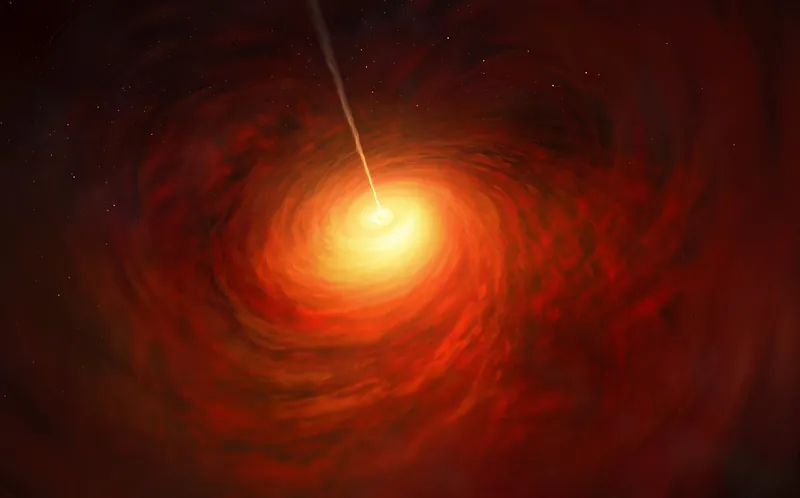
Most of the light we see comes from the accretion disk: gas that settles into a hot, bright, fast-spinning disk and slowly works its way in until it falls through the event horizon. NASA, anatomy
Gas pulled towards a black hole is heated to millions of degrees, so it glows in X-rays. NASA, 10 questions
Gas falling quickly into a black hole is thought to give off more than 100 times as much energy as the same mass would release by nuclear fusion. Britannica
Thin rings of light at the edge of the shadow are distorted images of the disk, made by light that has gone round the black hole several times before escaping. NASA, anatomy
One side of the disk usually looks brighter: gas spinning towards us looks brighter and bluer, and gas spinning away looks dimmer and redder. NASA, anatomy
Above the disk is the corona, a thin, turbulent cloud at about a billion degrees that gives out high-energy X-rays. NASA, anatomy
A little of the material heading in can be redirected into a pair of jets that blast away in opposite directions at close to the speed of light. NASA, anatomy The jets from supermassive black holes can be hundreds of thousands of light-years long. NASA, anatomy
The shadow
How big is the shadow? Sources differ
- NASA says the dark zone called the event horizon shadow is roughly twice as big as the black hole’s actual surface. NASA, anatomy
- Britannica says the shadow of the black hole in M87 is about five and a half times larger than its event horizon. Britannica
NASA gives a general rule of thumb; Britannica gives a figure for the black hole in M87. The size depends on how it is measured, so we give both.
The middle
Einstein’s general relativity predicts that the very centre holds a singularity, a point where matter is crushed to infinite density. NASA, anatomy
Nobody yet knows whether the singularity is a real physical thing or only a feature of the mathematics. It may mark the point where relativity stops working. NASA, anatomy
Black holes are much studied but not fully understood. Nobody knows, for example, what matter looks like inside the event horizon. NASA
How big is a black hole?
The radius of the event horizon is called the Schwarzschild radius, after the German astronomer Karl Schwarzschild. Britannica
The Schwarzschild radius is Rg = 2GM/c², where M is the mass, G is the gravitational constant and c is the speed of light. Britannica
The Schwarzschild radius goes up in proportion to the mass: twice the mass, twice the radius. Britannica
For a star like the Sun, the Schwarzschild radius is about 3 km (2 miles). Britannica
For a black hole with ten times the Sun’s mass, the radius would be 30 km (18.6 miles). Britannica
For something with the mass of a person it would be about 10⁻²³ cm, far smaller than the nucleus of an atom. Britannica
Try it yourself with the squash-it calculator.
Getting too close
Fall too close and the black hole’s pull would squeeze you sideways and stretch you lengthways like a noodle. Scientists really do call it spaghettification. NASA, 10 questions
It has never happened to anyone: black holes are too far away to pull in any matter from our solar system. NASA, 10 questions
Scientists have watched black holes tear stars apart, which releases a tremendous amount of energy. NASA, 10 questions
Finding the invisible
A hidden black hole can be weighed from the stars around it: their speeds show how massive the dark object is. NASA, 10 questions
Black holes bend light from things behind them. This gravitational lensing can reveal lonely black holes that would otherwise be invisible. NASA
All black holes spin. The fastest known, GRS 1915+105, turns more than 1,000 times a second. NASA
Our view: the strangest thing is not the singularity but the shadow. A black hole is photographed by the light it stops, not by any light of its own.
Next: kinds of black hole →