Hearing black holes collide
In 2015 two detectors in the USA felt space itself stretch and squeeze.
How this site works. Every fact is in our own words and linked to its source, beside it. Where good sources disagree, we show each version in a “Sources differ” box.
Ripples in space-time
Gravitational waves are ripples in space-time. They are made whenever a mass speeds up, like an ice-skater spinning or a pair of black holes circling each other. Nobel Prize, 2017
Einstein predicted gravitational waves about a hundred years earlier, but was convinced they could never be measured. Nobel Prize, 2017
Russell Hulse and Joseph Taylor’s pulsar, found in 1974, showed indirectly that gravitational waves exist, and won them the 1993 Nobel Prize in Physics. LIGO, 2016
14 September 2015
On 14 September 2015 gravitational waves were observed for the very first time. They came from a collision between two black holes. Nobel Prize, 2017
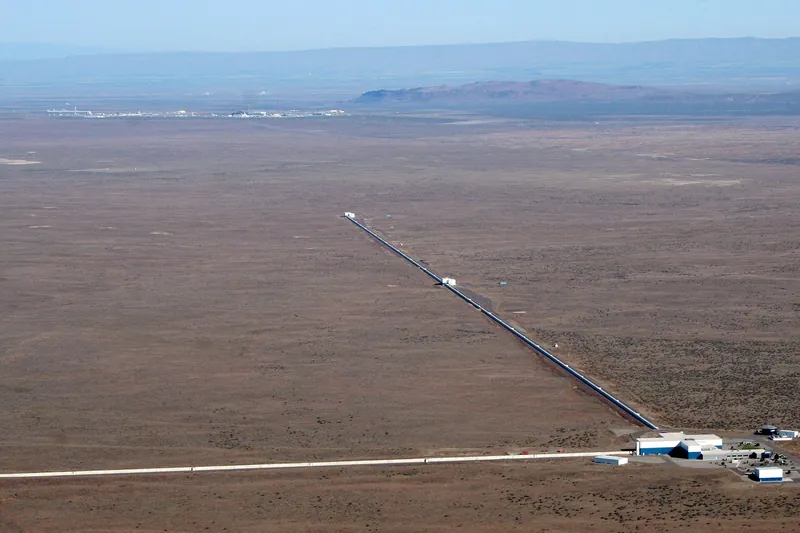
Both LIGO detectors, at Livingston, Louisiana, and Hanford, Washington, picked up the signal at 09:51 UTC. LIGO, 2016
Livingston recorded it 7 milliseconds before Hanford, which showed that the source lay in the southern sky. LIGO, 2016
The two black holes were about 29 and 36 times the mass of the Sun, and the collision happened 1.3 billion years ago. LIGO, 2016
The waves took 1.3 billion years to reach the LIGO detectors in the USA. Nobel Prize, 2017
In the final fraction of a second the two black holes collided at nearly half the speed of light. LIGO, 2016
About three Suns’ worth of mass was turned into gravitational waves in a fraction of a second, with a peak power about 50 times that of the whole visible universe. LIGO, 2016
How small?
LIGO measured a change thousands of times smaller than the nucleus of an atom as the wave passed Earth. Nobel Prize, 2017
The team and the prize
LIGO is a joint project of more than a thousand researchers from more than twenty countries. Nobel Prize, 2017
Rainer Weiss, Barry Barish and Kip Thorne won the 2017 Nobel Prize in Physics “for decisive contributions to the LIGO detector and the observation of gravitational waves”. Nobel Prize, 2017
What the waves tell us
Collisions of neutron stars and black holes make bigger black holes quickly, and send out gravitational waves. NASA, 10 questions
Before Gaia BH3, black holes of 30-odd Suns had only been detected in distant galaxies, through gravitational waves picked up by the LIGO–Virgo–KAGRA collaboration. ESA, 2024
Next: the history →