From a few Suns to billions
Astronomers sort black holes by how heavy they are. The boundaries are only rough.
How this site works. Every fact is in our own words and linked to its source, beside it. Where good sources disagree, we show each version in a “Sources differ” box.
Astronomers usually sort black holes by mass into three groups: stellar-mass, supermassive and intermediate-mass. The boundaries are only approximate. NASA, types
Stellar-mass black holes
When a star of more than eight times the Sun’s mass runs out of fuel, its core collapses, rebounds and explodes as a supernova. NASA, types
How heavy must a star be to make a black hole? Sources differ
- NASA says that if the star had around 20 times the Sun’s mass or more, its core collapses into a stellar-mass black hole. Near the threshold, it makes a city-sized neutron star instead. NASA, types
- Britannica says only the most massive stars, those of more than three solar masses, become black holes. Smaller ones end as white dwarfs or neutron stars. Britannica
NASA is talking about the star at the start; Britannica seems to be counting what is left at the end. Both say that stars like the Sun don’t make black holes.
A stellar-mass black hole can probably form in seconds, after a massive star collapses. NASA, 10 questions
Newborn stellar black holes range from a few to hundreds of times the Sun’s mass. NASA, types
Nearly all the stellar-mass black holes found so far were found because they are paired with a star. NASA, types
Pairs like these have revealed around 50 suspected or confirmed stellar-mass black holes in the Milky Way, but there may be as many as 100 million in our galaxy. NASA, types
The stellar black holes found in the Milky Way before 2024 averaged about 10 times the Sun’s mass. ESO, 2024
The lightest known black hole has only 3.8 times the Sun’s mass. It is paired up with a star. NASA
The Sun will never become a black hole. It isn’t massive enough to explode, and will end its life as a white dwarf. NASA, 10 questions
Cygnus X-1
Cygnus X-1, discovered in 1971, is a blue supergiant star and an invisible companion, a black hole, orbiting each other every 5.6 days. Britannica
Cygnus X-1 is about 6,070 light-years from Earth. NASA Chandra, 2011
Its event horizon spins round more than 800 times a second. NASA Chandra, 2011
Stephen Hawking lost a bet, first placed in 1974, that Cygnus X-1 did not contain a black hole. NASA Chandra, 2011
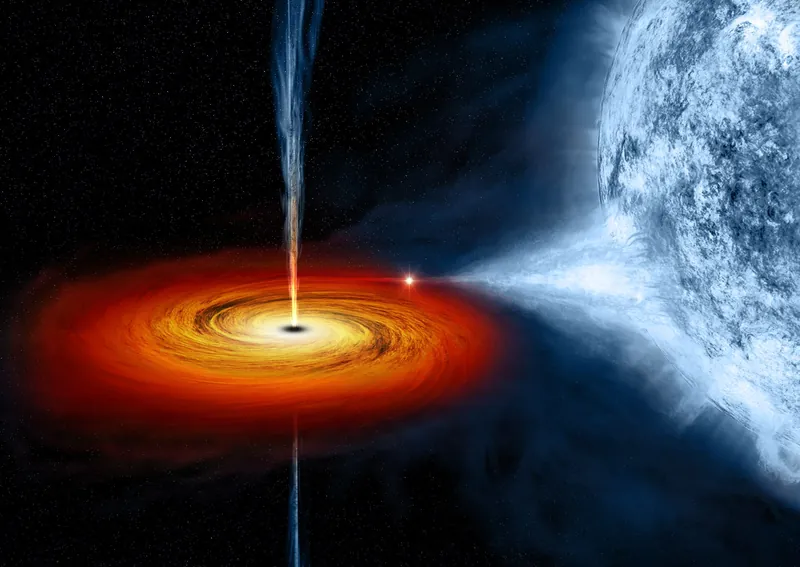
How heavy is Cygnus X-1? Sources differ
- In 2011 a NASA Chandra team gave the most precise mass yet for the Cygnus X-1 black hole: 14.8 times the Sun’s mass. NASA Chandra, 2011
- ESA’s 2024 release puts Cygnus X-1 at around 20 times the Sun’s mass. ESA, 2024
- ESO’s 2024 press release says Cygnus X-1 reaches 21 solar masses. ESO, 2024
The 2011 figure was the most precise of its time; the 2024 releases from ESO and ESA give later, higher figures. We give all three.
Gaia BH3 and our neighbours
The nearest known black hole, Gaia BH1, is about 1,500 light-years away. NASA
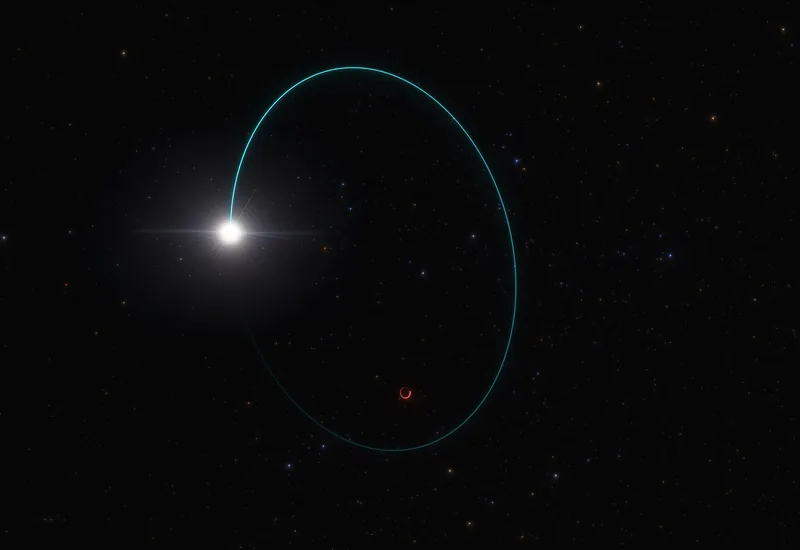
Gaia BH3, announced in April 2024, has about 33 times the Sun’s mass and lies about 2,000 light-years away in the constellation Aquila, making it the second-closest known black hole. ESO, 2024
It was the first black hole of stellar origin this big ever spotted in the Milky Way. ESA, 2024
Its companion is an ancient giant star that formed in the first two billion years after the Big Bang. ESA, 2024
Supermassive black holes
Almost every large galaxy, the Milky Way included, has a supermassive black hole at its centre, with hundreds of thousands to billions of times the Sun’s mass. NASA, types
Supermassive black holes grow by swallowing smaller objects, and by merging with each other when galaxies collide. NASA, types
Some supermassive black holes formed in the first billion years after the birth of the universe. How they started is still a mystery. NASA, types
The black hole at the centre of the galaxy Holmberg 15A holds at least 40 billion times the Sun’s mass. NASA, types
The most massive black hole yet observed, TON 618, has 66 billion times the Sun’s mass. NASA
The most distant
The most distant black hole: two NASA pages
- NASA’s black hole page lists the most distant black hole detected, at the centre of the galaxy QSO J0313-1806, as around 13 billion light-years away. NASA
- A 2019 NASA article put the most distant black hole then known in a galaxy about 13.1 billion light-years from Earth, seen as it was about 690 million years after the Big Bang. NASA, 10 questions
Records like this keep changing. The 2019 article was the record then; NASA’s main black hole page lists a different galaxy now.
In between: intermediate-mass
Intermediate-mass black holes, from about a hundred to hundreds of thousands of Suns, should exist, but the candidates have proved hard to confirm. NASA, types
One candidate, 3XMM J215022.4−055108, has about 50,000 times the Sun’s mass. NASA, types
Tiny and ancient: primordial black holes
Primordial black holes, if they exist, would have formed in the first second of the universe, with masses from 100,000 times less than a paperclip to 100,000 times more than the Sun. NASA, types
Nobody has yet found definite proof that primordial black holes ever existed. NASA, types
Theory says black holes with less mass than a mountain would evaporate faster than bigger ones, so many small early ones may have vanished completely. NASA, types