Photographing the unseeable
In 2019 the world saw a black hole for the first time. It took a telescope the size of Earth.
How this site works. Every fact is in our own words and linked to its source, beside it. Where good sources disagree, we show each version in a “Sources differ” box.
10 April 2019
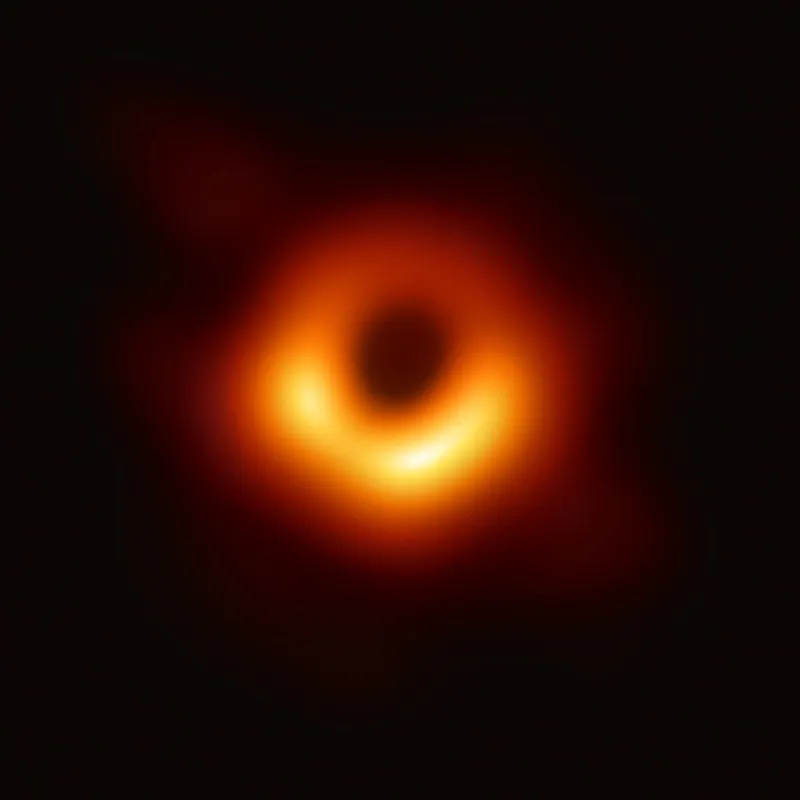
On 10 April 2019 the Event Horizon Telescope team revealed the first direct visual evidence of a supermassive black hole and its shadow. ESO, 2019
It is the black hole at the centre of Messier 87, a massive galaxy in the Virgo cluster: 55 million light-years away, with 6.5 billion times the mass of the Sun. ESO, 2019
Britannica says the M87 black hole, with six and a half billion Suns’ worth of mass, is only 38 billion km (24 billion miles) across. Britannica
The picture was made from data collected in 2017 and released in 2019. Britannica
An Earth-sized telescope
The Event Horizon Telescope linked eight radio telescopes on the ground into one virtual telescope the size of Earth. ESO, 2019
Its telescopes sat on volcanoes in Hawaii and Mexico, mountains in Arizona and Spain’s Sierra Nevada, in Chile’s Atacama Desert and in Antarctica. ESO, 2019
The telescopes were synchronised by a technique called very-long-baseline interferometry, using Earth’s rotation, and observed at a wavelength of 1.3 mm. ESO, 2019
Its sharpness, 20 micro-arcseconds, is enough to read a newspaper in New York from a café in Paris. ESO, 2019
ALMA in Chile, with 66 high-precision antennas, was the most sensitive telescope in the network. ESO, 2019
Since 2017 the network has added the Greenland Telescope, the NOEMA array and the 12-metre telescope on Kitt Peak. ESO, 2022
Making the picture
Petabytes of raw data were combined by specialised supercomputers at the Max Planck Institute for Radio Astronomy and MIT Haystack Observatory. ESO, 2019
More than 200 researchers worked on the first picture. ESO, 2019
The result was published in six papers in a special issue of The Astrophysical Journal Letters. ESO, 2019
Why one side is brighter
The ring is brighter on one side because the black hole is spinning: light from material turning towards Earth is boosted. Britannica
NASA says the dark zone called the event horizon shadow is roughly twice as big as the black hole’s actual surface. NASA, anatomy
Our own black hole was pictured three years later; that story is on the Sagittarius A* page.
Our view: the pictures are blurry, and that is the point. Each one is the sharpest view humans have ever had of anything in the sky.
Next: gravitational waves →